



Learn the language of the NICU
Click through our glossary to learn more about the terms and phrases you might hear your baby’s care team using. You can click on the letters below to jump to the words starting with each letter.
A B C D E F G H I J K L M N O P R S T U V
A
| ABO incompatability |
| Occurs when the mother has a blood type that does not match with baby’s blood type. It can cause jaundice and anemia in the baby, which will be monitored. |
| Acidosis |
| An excess of acid in the blood. |
| Arterial line |
| A catheter placed in the artery to monitor blood pressure (invasive) and can be used to draw blood work. |
| Anemia |
| Low level of red blood cells or hemoglobin in the body. |
| Antibiotics |
| Medicine used to treat bacterial infection |
| Apgar Score |
| Scoring tool used at birth that gives a quick idea of how well your baby is doing in the first few minutes of life. |
| Apnea |
| A pause in breathing that lasts more than 20 seconds. Common in premature babies. |
| Aspirate/Aspiration |
|
B
| Bilirubin |
| Yellowish substance made when red blood cells are broken down. Normally processed by the liver and excreted in urine and stool. When it builds up you can notice your baby’s skin or eyes having a yellow/orange colour. |
| Bili lights |
| Phototherapy or light treatment that breaks down bilirubin to prevent or treat jaundice. |
| Breast milk fortifier |
| Calories and nutrients added to breast milk. May be in powder or liquid form. |
| Blood gas |
| Blood sample that tells us how well your baby is exchanging oxygen and carbon dioxide when they breathe. |
| Birth weight |
| Measured weight at the time of birth. Sometimes birth weight may be estimated depending on your baby’s condition. |
| Blood pressure |
| Can be measured non-invasive lay by using a pressure cuff that inflates or measured invasively by an arterial line in the arms, legs or umbilical cord. |
| Bolus |
| An amount of fluid given over a short period of time. |
| Bradycardia |
| Slow heart rate. In babies this is noted as under 100 and often worrisome under 60 beats per minute. |
C
| Catheter |
| A thin, flexible, plastic tube. There are many types and it may go by different names depending on where it is placed. |
| Chest X-ray |
| An X-ray to look at your baby’s chest to see placement of tubes or look at the condition of their lungs or heart. |
| Chest Tube |
| Inserted by a physician or advanced practitioner. A chest tube is used to drain fluid or air in the lungs. |
| CPAP |
| Continuous positive airway pressure. A machine to help your baby breathe that pushes air through a mask or prongs in their nose to help keep the smallest air sacs in their lungs open and make it easier for them to breathe. |
| Cyanosis |
| A blueish colour that is caused by low oxygen saturation. Acrocyanosis is a blueish colour to the hands and feet which can be normal during the first few days of life. |
| Corrected Gestational Age |
| The baby’s current age in weeks, starting from the date of conception. For example, a baby born at 35 weeks gestation who is now 5 weeks old would be 40 weeks corrected (term). |
D
| Desaturation (desat) |
| When the oxygen level in the blood falls below a set target. This target may vary depending on the baby’s age or condition. |
E
| EBM |
| Expressed breast milk. The milk a mother produces. |
| ECHO |
| Echocardiogram is an ultrasound of the heart that shows the structure and function of the heart. |
| Edema |
| Swelling caused by extra fluid in the tissues of the skin. |
| Electrolytes |
| Important chemicals such as sodium and potassium in the blood that must be in balance for the body to work properly. |
| Exchange Transfusion |
| Extremely high levels of bilirubin may need to be treated by removing blood from the baby and exchanging it with donor blood to bring down their bilirubin levels. |
| Extubation |
| Removing a breathing tube. |
F
| Fontanelle |
| There are two soft spots on a baby’s head where skull bones have not yet come together. These are normal and will close within a year. |
| Full Term |
| A baby who is born between 37-42 weeks gestation |
G
| Gastroschisis |
| A birth defect that allows an opening of the abdominal wall and the baby is born with abdominal organs outside the body. |
| Gavage feed |
| Feeding by a tube in the nose (NG) or mouth (OG) which is common when a baby is too premature to eat, or has breathing, digestive or other issues that don’t allow them to take food by bottle or breast. |
| Gestational Age |
| The length of time between conception and birth, measured in weeks and days. |
| GERD |
| Reflux (or gastroesophageal reflux disease) similar to heartburn, when stomach contents come back up the esophagus. This may cause discomfort or cause premature babies to spell. |
| GBS |
| Group B Streptococcus is one of the most common infections babies can be born with and can be quite serious for them. Mothers are routinely swabbed for this around 36 weeks gestation and given antibiotics before the baby is born if possible. |
| G-Tube |
| Feeding tube on the abdomen that is surgically placed directly to the stomach. Used for babies who cannot feed by mouth for the long term. |
H
| Head Ultrasound |
| Test to check brain structure and blood flow. Routinely monitored in premature babies who are at risk for brain bleeds due to the fragile vessels in their brain. |
| Heel Prick/Poke/Stick |
| A way to take blood for testing but using a small lancet on the baby’s heel. Also known as a cap (capillary) sample. |
| HFO |
| High frequency oscillation. A type of breathing machine that provides tiny, fast breaths that makes your baby’s chest appear to wiggle. It is a gentle mode of ventilation used when we have difficulty with conventional breaths. |
| High flow oxygen |
| Similar to CPAP, a non-invasive breathing support. |
| Heart Murmur |
| Additional sound heard in a baby’s heartbeat. Sometimes normal in the first day or two of life, but may be an abnormal finding. |
| Hypoglycemia |
| Low blood sugar (glucose) level |
| Hypotension |
| Low blood pressure |
I
| Infusion |
| Slow, continuous introduction of a solution or fluid into the bloodstream. |
| Intubation |
| Procedure of placing an endotracheal tube in an airway. |
| IVH |
| Intraventricular hemorrhage. A bleed in the brain (into the brain’s usually fluid-filled ventricles) that is common in premature babies. Graded on severity from 1-4. |
| Isolette |
| Heated, humidified, double-walled bed for premature babies. |
| IUGR- Intrauterine growth restriction. |
| Term used when a baby has slow growth in utero. |
J
| Jaundice |
| Yellow colour seen in the skin and eyes common in newborns within the first couple weeks of life. Measured by the bilirubin level which is caused by the breakdown of red cells. If levels are too high, baby may need phototherapy (bili lights) to treat it. |
K
| Kangaroo Care |
| Parent holding and undressed baby skin-to-skin on their bare chest. |
L
| Lipids |
| Fats delivered by IV which is one part of TPN |
| Long line |
| Short of a central line, a long line can deliver IV fluids and medications and remain inserted for up to 30 days. |
| Level III-B unit |
| Unit classification that will care for babies of any gestation who require surgical or specialized care. |
| Lumbar Puncture |
| Also called a spinal tap. A needle is placed in the lower spine to remove a small amount of spinal fluid for testing. Often used to detect infection in the brain called meningitis. |
M
| MRI |
| Magnetic resonance imaging is a test that provides a detailed view of the structures in the body. There are other MR tests that can be performed as well. This is one of the few tests babies must be brought out of the NICU to have done. |
| Meconium |
| Dark black or brown, sticky stool babies pass in the first few days. |
| Meningitis |
| Infection in the brain that is confirmed with a lumbar puncture to test the cerebrospinal fluid (CSF) |
N
| NEC |
| Necrotizing enterocolitis. A condition in the gut of neonates where the wall of the bowel swells and becomes fragile or loses blood flow. It can be very dangerous. The gut may only require some rest and antibiotic treatment before resuming feeds slowly, but in severe cases it may require surgery. |
| Neonatal |
| The newborn period of the first 28 days of life. |
| Newborn Screen |
| Metabolic screen done on all babies in Ontario. It consists of 5 drops of blood on a paper, usually done by a heel poke. It tests for 5 groups of diseases that are treatable but not usually detected in the newborn period. |
| NG or feeding tube |
| Nasogastric tube (NG) is inserted in the nose and travels to the stomach. It can be used for feeding or for draining the contents of the stomach. |
| Nasal Prongs |
| Small, flexible tube that delivers oxygen into a baby’s nose. |
| Nitric Oxide |
| Gas delivered to open the airways in babies with high pressures in their lungs (pulmonary hypertension) |
O
| OIT |
| Oral Immune Therapy involves giving a small drop of freshly expressed breast milk into a baby’s mouth. It allows them to receive antibodies and benefits from the milk before they may be able to feed. |
P
| PDA |
| Patent Ductus Arteriosus. A blood vessel that keeps blood away from the lungs when the baby is in utero (when lungs are fluid filled) and usually closes shortly after birth. When it stays open (patent) longer than normal it may interfere with normal blood flow and heart and lung function. We may try medication to close it, or surgery may be necessary. |
| PHDM |
| Pasteurized Human Donor Milk. Human breast milk that has been donated to a bank and sterilized to rid it of any possible infection. It still contains many benefits of breast milk and may be easier to digest than formula. It is given to babies who meet certain criteria and may not have their own mother’s milk. |
| PICC line |
| Peripherally inserted central catheter looks similar to a regular IV in the arm or leg, but it is a long line that is threaded through the vein to sit at the larger vessels of the heart. It can deliver TPN or medications for as long as needed. |
| PIV |
| A peripheral Intravenous is a regular IV. In babies can be inserted into a vein in the hands, feet, arms, legs, or very superficially in the scalp. Babies don’t instinctively protect their IV as adults do. Combined with their fragile veins, the sites don’t always last very long. |
| Preterm or premature |
| A baby born before 37 weeks gestation. |
| Pneumothorax |
| Medical term for a collapsed lung. It is a pocket of air in the space between the lungs and the chest wall. Larger air leaks may need a needle or chest tube to remove the air as it becomes very difficult to breathe. |
| Phototherapy |
| Blue lights that help to lower bilirubin levels and treat jaundice. |
| PPHN |
| Persistent pulmonary hypertension of the newborn is high blood pressure in the lungs. This makes it difficult to exchange gasses properly and results in breathing problems. |
| Pre/post saturations |
| A measurement of oxygen saturations on the baby’s right hand/wrist and another limb. This gives a quick measure of worsening pulmonary hypertension or a heart condition. |
R
| Reflux |
|
Similar to acid reflux. Stomach contents backing up into the esophagus. May be painful and may cause small babies to briefly drop their heart rate or stop breathing (spell) |
| Replogle Tube |
| Used to keep the airway clear in babies with TEF. It is inserted in the nose or mouth to the back of their throat where their esophagus comes to an end. It has 2 channels in the tube. One continuously infuses saline, while the other continuously suctions away the saline and secretions. |
| Retractions |
| Pulling in of muscles that indicates increased work of breathing. |
| RDS |
| Respiratory distress syndrome is a breathing problem caused by lack of surfactant in premature babies. |
| ROP |
| Retinopathy of prematurity is a disease that affects immature blood vessels in the premature baby’s eye. Babies less than 30 weeks gestation are scheduled for regular eye checkups. In severe cases a laser treatment may be needed. |
| RSV |
| Respiratory syncytial virus is similar to a cold, a respiratory infection that can be serious for premature infants and all newborn babies. Some babies will qualify for a vaccine and require this monthly if they are sent home between November-April. |
S
| Saturation |
| Percentage of oxygen present and measured in the blood. The red light sensor on your baby’s hand or foot is measuring this. |
| Skin to skin |
| See Kangaroo Care under letter K. |
| Sepsis |
| A blood infection that requires treatment with antibiotics. |
| Spell |
| Apnea and bradycardia in premature babies. Apnea is a pause in breathing of at least 20 seconds that causes their heart rate to drop (bradycardia) and usually accompanied by a drop in their oxygen saturation. It is commonly due to immature breathing centers in the brain and should resolve as they reach term. Sometimes these resolve quickly on their own, but they may require stimulation or intervention to correct. |
| Stoma |
| Surgical opening connected to the bladder or bowel that allows waste (urine or feces) to drain out. When connected to the bowel, the name defines which part of the bowel it is connected to, usually colostomy (colon) ileostomy (ileum) or jejunostomy (jejunum). It appears as a small, round, pink piece of flesh attached to the outside of the body. It is covered with a bag to collect the waste. |
| Sucrose |
| 24% sucrose is a form of sugar in water (less sugar than common syrups such as antibiotics or fever medication) and it’s been proven to reduce pain during tests and treatments in babies up to 18 months. |
| Suction |
| Removal of secretions or mucous from lungs, breathing tube, or airway. |
| Surfactant |
| Slippery, soapy substance that allows your baby’s lungs to easily open and exchange oxygen. Babies born before 34 weeks may not have produced enough surfactant and may require it to be given via a breathing tube. |
T
| Tachycardia |
| Abnormally fast heart beat. |
| TEF |
| Tracheoesophageal fistula is a birth defect where there is a small connection between the baby’s windpipe (trachea) and food pipe (esophagus). This will require a surgical correction. See Special Conditions below. |
| TFI |
| Total Fluid Intake. This is a set number of milliliters based on your babies age and condition that they need per day. This number is always multiplied by their weight. It is expressed in mLs/kg/day. |
| Tube (ETT) |
| Breathing tube. It can be inserted in the nose or mouth to assist a baby with mechanical ventilation. It requires special monitoring and is always at risk of being accidentally removed. |
| Transfusion |
| Premature babies may have immature marrow and not produce blood quickly enough. Sometimes oral iron may help boost their stores, but some may require a blood transfusion. |
| TTN |
| Transient tachypnea of the newborn is caused by fluid on the lung after birth causing the baby to breathe very quickly. Your baby may need pressure of CPAP and may not be able to feed by mouth while they are breathing so quickly. |
| Tachypnea |
| Fast breathing rate |
| TPN |
| Total parenteral nutrition is vitamins, proteins, sugars, minerals and fats your baby needs to grow well given by an IV or central line. |
U
| UAC |
| Umbilical arterial catheter is a central line placed in the belly button’s artery to monitor blood pressure and may be used for blood sampling. |
| UVC |
| Umbilical venous catheter is inserted in the vein in the belly button and is used to deliver fluid, medicine or nutrition to your baby. |
V
| Ventilator |
| A machine that helps your baby breathe. Monitored by the Respiratory Therapist. |
Daily rounds
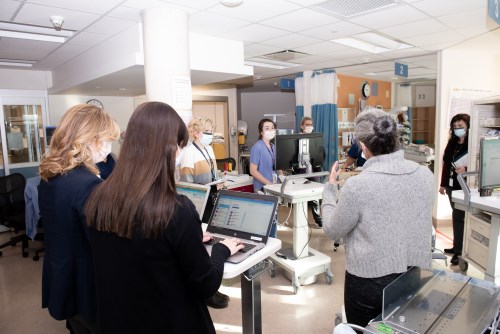
Every day our NICU Team meets for their daily rounds. Rounds start at 9:30 but it takes a few hours to get around to each patient. The team reviews your baby’s condition over the last 24 hours and makes a plan for the next 24 hours. There is sometimes open discussion or teaching for residents included and a lot of medical terms being said. The team will make sure that you understand all of the important pieces of what was said and give you an opportunity to ask questions. Some parents find it helpful to write down their questions so they don’t forget them when the whole team is there to ask. If a lengthier discussion is needed on a certain topic, sometimes we need to prioritize and come back later to discuss details.
We can arrange to have you attend rounds by secure video conference or fill you in on discussions later in the day if you cannot be there in person.

Handling times
Because sleep is so important for your baby’s development, we try our best to set a schedule for your baby’s care or “handling” to minimize disruptions. If your baby is being fed, all of their care is then clustered around their feeding times. Often these times are every three hours and either start from 8am or 9am and continue around the clock every 3 hours.
If your baby is not being fed, we may aim to provide care every 4 hours. There may be occasions we will adjust these times to coordinate with a test that needs to be done or based on your baby’s cues.
Interacting with your baby
Sometimes the tubes and wires can be scary and overwhelming. Your baby is still there behind all of it and there are many things you can do to care for them. You can talk or sing to your baby in a quiet voice, but sometimes it is hard to know what to say to your baby. For these times, we are lucky to have books donated to the unit as a special gift from the family of Jack & Mia. You can read this book that is given to your family or any other book you choose to bring in.
You can also hold their hand or show them a small toy. If they are well enough you may be able to try supervised tummy time to help strengthen their back and neck muscles.
You can always get involved in your baby’s care by taking their temperature and washing their face or cleaning their mouth and eyes when needed. You may need some help with the wires at first, but you can help change your baby’s diaper around the time of their feed or handling time.
Family members who cannot visit in-person may want to spend time with the baby by video call. We kindly ask that you use earphones and a quiet voice to respect the space of the other babies in the unit.
Bathing and care
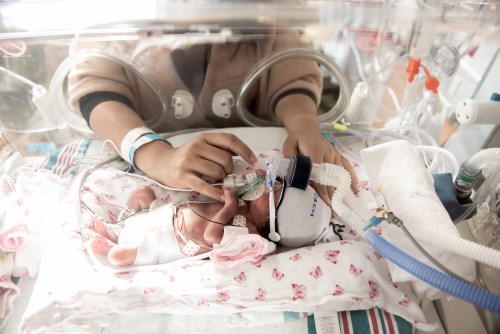
When your baby first arrives in the NICU, they usually have several tests or procedures, consults, or exams from physicians which makes daytime quite busy. We also like to give you time to cuddle your baby during the day. This means that we usually reserve bath time for the night shift as there is more available time. Weights tend to be done at the same time as the bath and on Saturday nights we take all of your baby’s weekly measurements (height and head circumference).
As your baby gets better and is moving closer to home, days become less busy with tests and procedures. At this point we encourage parents and caregivers to be more involved in daily care and we can teach you how to bathe your baby during the day or evening if you prefer. While this routine usually works well, let us know early if there is another arrangement that we can try to accommodate.
With your baby’s handling times, you’re welcome to provide care such as eye and mouth care when needed and a diaper change. The nurses will help you navigate all of the equipment and wires.
Feeding, supports and pumps
It is common in the NICU that babies are not ready to feed by mouth for the first while for various reasons depending on their condition. In this case, your baby will receive all of the nutrition they need via an IV. This total parenteral nutrition is called TPN and is made up of sugar, electrolytes, vitamins and the fats your baby needs to grow. It is made especially for your baby based on their blood values.
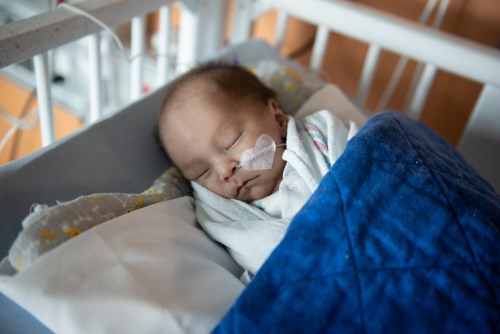
If your baby is ready to receive small amounts of breast milk or formula, this will be offered by a nasogastric tube (NG). The NG tube is inserted in their nose or mouth, travels down their esophagus to their stomach and can deliver milk. If your baby has no issues breathing and is showing signs that they are ready to bottle, breastfeed or chestfeed, they will be allowed to try feeding by mouth. Sometimes it takes a few tries for them to learn how to feed by mouth and build enough energy to get through an entire feed. We often use a feeding tube to give any remaining milk they were unable to take by mouth.
All of our nurses have extensive training and experience helping mothers with breastfeeding or chestfeeding.
From day one we will get you set up with a breast pump and all the information you need to know about pumping. We have pumps available at the bedside and will provide you with one breast pump kit for your stay. It is your responsibility to care for the kit and safely store your milk. If possible, we would like to use fresh milk to feed your baby. Any milk not being used within one hour after pumping needs to be kept cold in the refrigerator or on ice and labeled with the date and time you pumped. Our pumps cannot be removed from the hospital. If you choose to go home overnight and need to pump, you may need to purchase or rent a pump for home. We can instruct you where to find a rental pump. In the meantime, you can always use hand expression to help keep your supply up and for comfort.
Expressed breast milk (EBM) can be stored:
- in the fridge for up to 48 hours
- in the freezer up to 3 months
- in a deep freezer up to 6 months
Once thawed out, it is good for 24 hours.
Kangaroo care
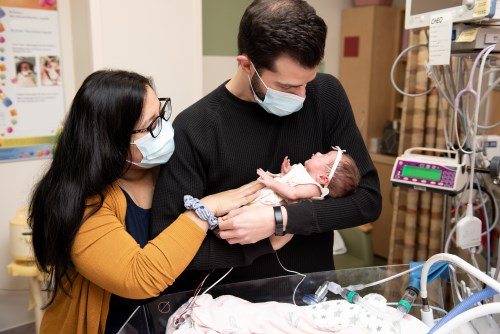
As much as possible, we encourage all parents to provide kangaroo care which involves uninterrupted time for either parent to hold your baby skin to skin. Your baby will be in just a diaper and rest on your bare chest.
We recommend that you make sure you’ve had something to eat and drink and gone to the bathroom prior to holding your baby. This will help make sure you are available for at least 60 minutes but kangaroo care can last several hours if you’re able. It can take some time after transferring to your skin before your baby really settles in and it is best to minimize disruption. This time is so precious with your baby and we advise you to soak it all in and not pick up your phone and maintain skin to skin contact with your baby for as long as possible.
Benefit of Kangaroo Care for babies
Skin-to-skin or kangaroo care has been shown to have many benefits for your baby. It helps them:
- Regulate their breathing, heart rate and temperature
- Prepare them for breastfeeding or chestfeeding
- Manage pain during painful procedures
- Decrease crying and stress
Studies show when you and your baby are skin to skin in the same environment, you produce antibodies to microorganisms in this environment which. These antibodies appear in your breast milk within a few hours and the immunity is passed on to your baby. It also is shown to help with sleep and brain development
Benefits of Kangaroo Care for parents:
- decreases parental stress
- helps you gain confidence in caring for your baby
- is an opportunity to bond with your baby
- improves milk production and eases the transition to breastfeeding or chestfeeding
- decreases risk of postpartum depression
Modified Kangaroo Care
If your baby’s condition prevents them from being held, there are modified forms of kangaroo care you can provide.
Finger Holding – your baby can hold your finger as a comfort measure
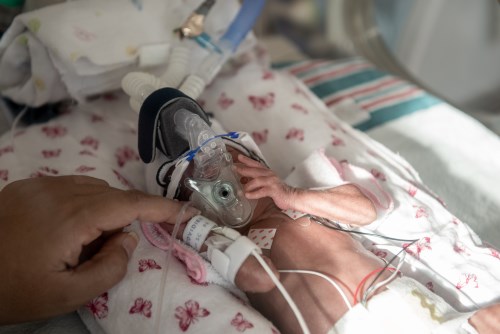
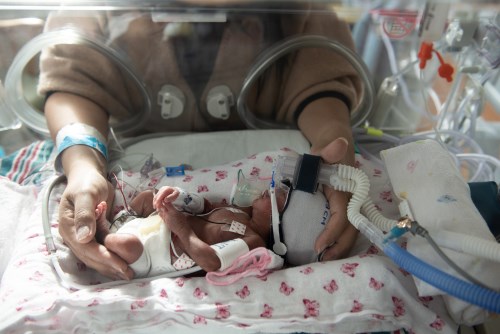
Hand hugging – place one hand around your baby’s head and the other cupping their feet to help calm them and feel secure.
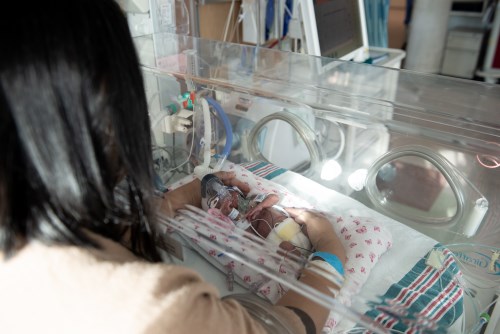
Nesting or encircling baby – you can lean over their bed and wrap your arms around your baby
More information
Linens and clothes
Bravery beads
Transition to pediatric care
As your baby’s health improves, they may not need NICU care any longer. If they are not requiring the specialty care of our NICU, there are times when it is appropriate to send them back to their birth hospital or transition to another unit at CHEO before they’re ready for home. While the care may look different in different areas, know that this is a positive move towards the goal of you bringing your baby home. This will give you the opportunity to become even more involved in your baby’s everyday care.
What you can do to ease this transition?
Get involved in your baby’s care early on. While you are in the NICU, try to learn as much as you can to become the expert in your baby’s care. If your next step is the inpatient wards at CHEO, parents are expected to stay with their baby. Most parents who have had their baby home already want to stay and are used to caring for their child. This parent-led care model can be a big change for parents of babies who have been in the NICU but this is progress towards going home! Learning how to lead your baby’s care early on will help.
Ask for help! Child Life is there to improve your child’s experience. They can help coordinate volunteers to cuddle your baby when you need a break. Social Workers are there to support you and help you navigate the health care system. Spiritual Support are there to listen and help you through difficult times. Patient Experience is there to respond to questions or concerns you may have about your time at the hospital.
link