



Dawn was still breaking between the peaks of California’s Klamath Mountains when Humboldt County police officers found a student dead at the local high school. It was an apparent suicide.
McKinleyville High School, where the student was discovered at around 6:30 am, closed for the remainder of the day. And as residents of the rural California county bordering the Pacific Ocean reeled from the news, the school partnered with its community and family centers to provide grief counseling for its students.
“The strength of our school is that we are a family and in these moments coming together to support one another is what we need and what we do best,” wrote the school’s principal, Nic Collart, in a letter to students and families that day. “I love you all very much.”
The year was 2019.
Five years later, in the 2024-25 school year, district leaders for the neighboring McKinleyville Union School District were attempting to hire more mental health professionals to serve students. The district had just one counselor, two psychologists and no social workers for over 800 students across three school campuses covering transitional kindergarten through grade 8.
But later that school year, the district was making progress. It had won a $7.2 million grant in October 2024 from the U.S. Department of Education that over the next five years would help it hire the equivalent of six full-time credentialed school social workers, psychologists or counselors. With the money, it would also be able to hire three full-time instructional coaches for a multi-tiered system of supports, a widely used intervention system that provides a broad range of supports based on students’ academic and mental health needs..
However, almost five months into its mental healthcare system overhaul, the rug was pulled out from under the district’s plans.
On April 29, 2025, the district received notice from the Education Department that its funding was being yanked. The school district’s plans for the federal funds, it was told, “reflect the prior Administration’s priorities and policy preferences and conflict with those of the current Administration.” Using the money in this way “no longer effectuates the best interest of the Federal Government,” the agency told McKinleyville USD.
In canceling about $5.9 million of the funding, the Trump administration effectively ended the district’s grant. The move figured among at least $1 billion in canceled Education Department mental health and professional demonstration grants across schools, districts, consortia and universities nationwide.
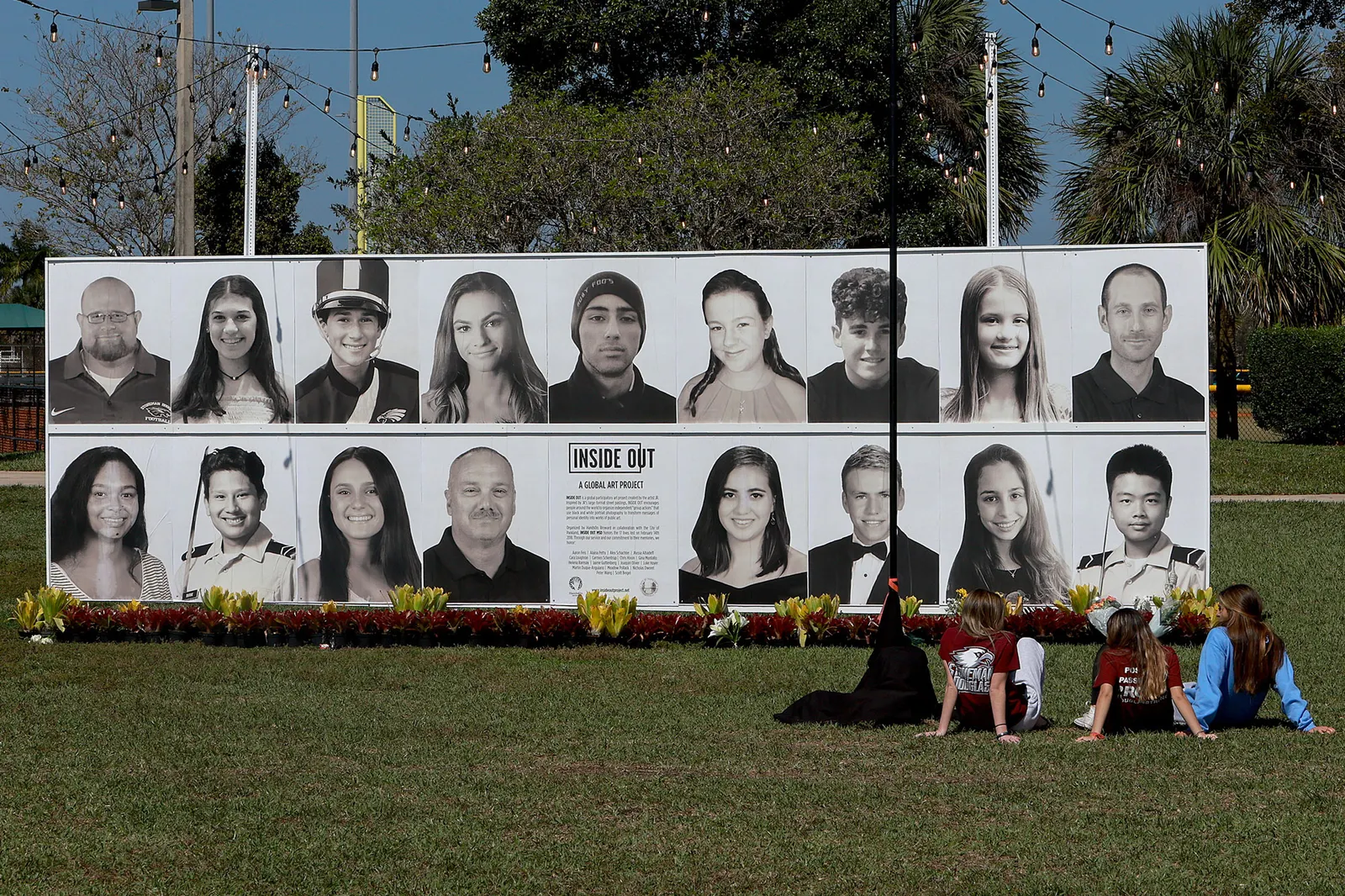
People sit in front of a photo display of the 17 people killed at Marjory Stoneman Douglas High School during a mass shooting on Feb. 14, 2022, in Pine Trails Park in Parkland, Fla.
Joe Raedle via Getty Images
‘We did everything that the federal government asked of us’
On the other side of the country and just a year prior to the 2019 apparent student suicide at McKinleyville High School,17 students and staff had been brutally murdered in a mass shooting at Marjory Stoneman Douglas High School in Parkland, Florida. The tragedy once again shone a national spotlight on the importance of supporting youth mental health and, in a relatively rare act of bipartisanship, led Congress to establish two grant programs to support the mental health of K-12 students.
By 2022, after another mass school shooting — this time taking the lives of 19 children and two teachers in Uvalde, Texas — Congress had allocated over $1 billion for the School-Based Mental Health and Mental Health Service Professional Demonstration Grant programs.
Among the Biden administration’s goals for the grants were: increasing recruitment and retention for school-based mental health services providers, providing training for existing mental health services providers to qualify them to work in school districts, and increasing “the diversity, and cultural and linguistic competency, of school-based mental health services providers, including competency in providing identity-safe services.” The grants would be available to districts that “demonstrated need.”
McKinleyville Union School District seemed to fit the bill.

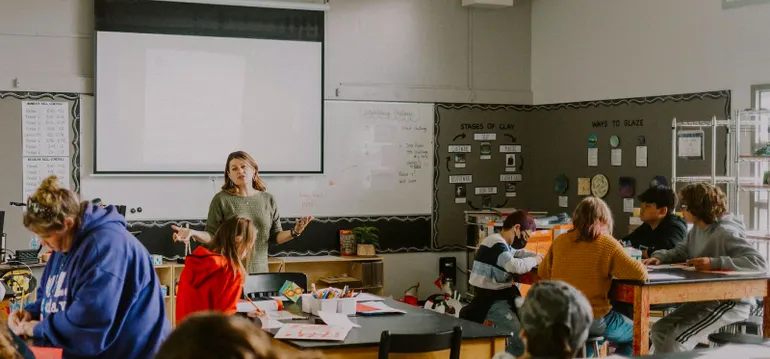
Elementary school students learning during class in McKinleyville Union School District in Humboldt County, Calif.
Permission granted by Wylde Aura Photo Co.
It sits in a county with the highest rate of adverse childhood experiences in California. Over half — 58% — of Humboldt County’s children have multiple such experiences in an area that is considered a mental healthcare desert. Around 60% of the district’s students are from low-income families.
McKinleyville USD is one of 32 school districts serving Humboldt County, California, with the five-school Northern Humboldt Union High School District — where McKinleyville High School sits — being another.
If students are not served at school, in far too many cases, they will not be served at all.

McKinleyville Union School District
Request to the U.S. Education Department
The tribal lands scattered across the county are home to Native American students, who make up about 9% of the county’s students. Nationwide, the Native American population overall had a suicide rate 91% higher than other Americans in 2022, per the Centers for Disease Control and Prevention.
“Families with private insurance through work are often unable to find a clinician. Their only options are telehealth or driving up to five hours on narrow and often closed highways to the nearest metropolitan areas,” the school district said in its plea to the Trump Education Department to reverse the cancellation of its grant. “If students are not served at school, in far too many cases, they will not be served at all.”
The Biden administration’s Education Department had awarded the grant in 2024 to use through 2029.
Part of the funds, according to the district’s application, were to help raise the “diversity” of providers to 50% — up from what it reported as a “credentialed workforce [that] is 88% white.” Its application also said “the hiring qualifications will stress a strong understanding of and experience working with the communities that comprise local underrepresented groups.”
It was that priority that would lead the Trump administration to abruptly end the district’s funding stream less than a year later.
“We did everything that the federal government asked of us, and now our funding is gone,” said Julie Giannini-Previde, superintendent of McKinleyville Union School District, in a press call in late October.
In a May 2025 letter to the department, the district said it was “open to modifying the project in accordance with the Administration’s priorities to ensure our high needs, [and that] rural students and families are supported and successful in school and in time, in life.”
Part of the challenge the district wanted to address through the original funding priorities included in its grant application was the generational trauma affecting today’s students, it said in its original grant application to the Biden administration. Angela Sundberg, social services director at Trinidad Rancheria and part of the Yurok Tribe in Humboldt County, traced this trauma to what students’ family members had been subjected to in federally funded boarding schools meant to assimilate Native Americans in the 19th and 20th centuries.
“The boarding schools are the reasons why we are experiencing a lot of the trauma that we continue to face,” said Sundberg.
It is not the role of school psychologists to promote particular ideologies or stereotypes when addressing the mental health needs of students.
U.S. Department of Education
New priorities for school mental health grants
That trauma includes neglect, physical abuse and addiction, she said on the press call. “So finding somebody who is going to be able to focus and have that education on where our kids are coming from is even more important.”
Nonetheless, Trump’s Education Department revoked the district’s grant despite the district’s pleas to reconsider its April 29 discontinuation decision. In a September 2025 response, the Education Department said the district’s request “was not sufficient.”
Lindsey Burke, the department’s deputy chief of staff for policy and programs, warned that any failure to return the grant money could impact the district’s ability to receive funds in the future and “result in additional liabilities.”
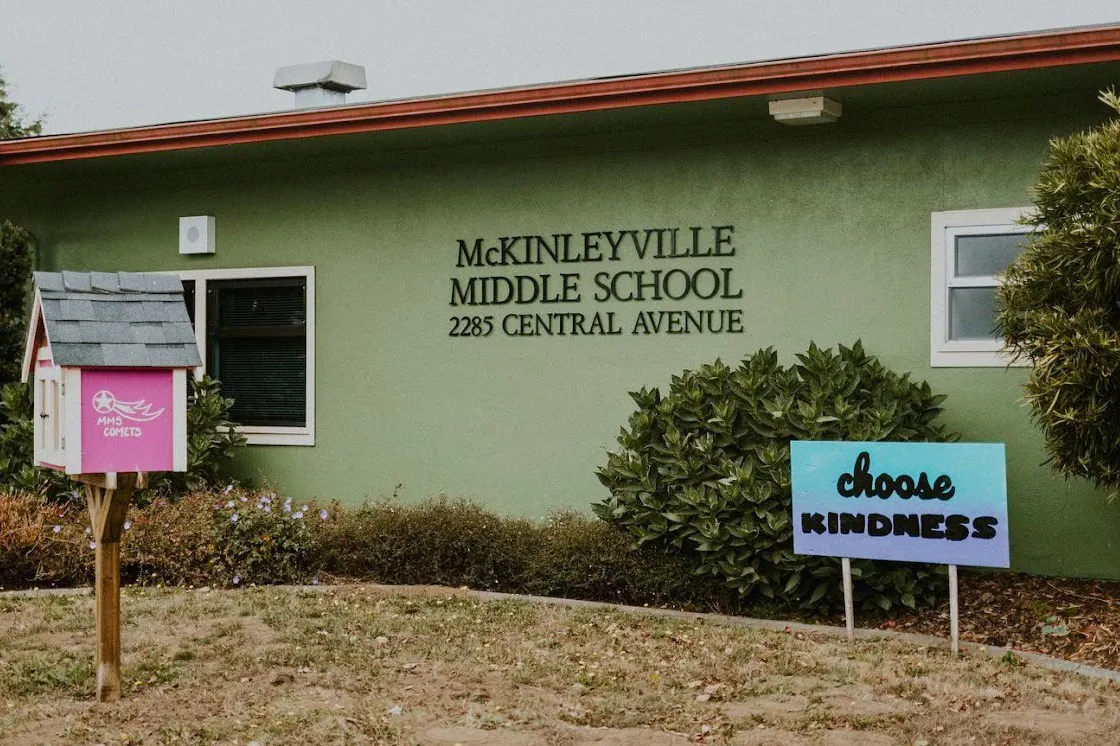
McKinleyville Middle School is one of three school campuses in the McKinleyville Union School District in McKinleyville, Calif.
Permission granted by Wylde Aura Photo Co.
‘A case of life or death’
Then, late last month, McKinleyville Union School District took the department to court.
In its lawsuit, it claims the department — under its own federal regulations — can only discontinue a grant based on the district’s performance, and only after its first performance review in a multi-year grant period. That was a benchmark the district had not yet reached. Its first interim report was due at the end of October, and its first annual performance report was not due until February 2026.
While it was not the first to take the administration to court over the canceled mental health grants, its legal challenge is among the first to challenge what many had warned: that President Donald Trump’s efforts to downsize the federal government, shut the federal Education Department, and halt diversity initiatives in education would significantly harm rural communities.
The Education Department did revive the school-based mental health grants in September. Under revamped priorities and a new application period, grant money may not be used for “promoting or endorsing gender ideology, political activism, racial stereotyping, or hostile environments for students of particular races.” And under the new application, the original awards revoked from districts and other entities were not restored.
Amanda Mangaser Savage, strategic litigation counsel at Public Counsel, which filed the lawsuit on behalf of McKinleyville USD, said during the press call announcing the lawsuit, “It’s a purely sort of ideological disagreement that takes into account nothing unique to the school district, unique to the children here, unique to the tribes that are present in this county.”
The Education Department had proposed new priorities for the mental health grants in July and received varying feedback. According to the department, some said the new priorities “could create barriers to access for needed mental health services,” such as for students from different racial backgrounds or LGBTQ+ students. But others expressed support for parental consent and limiting “gender ideology”.
In the end, the Education Department said in its finalized priorities in September: “It is not the role of school psychologists to promote particular ideologies or stereotypes when addressing the mental health needs of students.” The intent of the new priorities, it said, “is not to harm or limit services to students, but to ensure that program funds are particularly focused on providing targeted mental health services without tying such services to particular ideologies or stereotypes.”
Losing this level of support for our kids could literally be a case of life or death for some of our students.
Julie Giannini-Previde
Superintendent, McKinleyville Union School District
The agency refused to define its limitations such as “racial stereotyping” and “political activism,” saying the “terms are commonly used and understood.”
The new priorities also limit the use of funds to services provided by school psychologists and omit services from other mental health service providers like counselors, social workers, and general psychologists.
A coalition of 16 states, including California, filed a separate lawsuit challenging the canceled grants in June. The attorneys general said in a statement that the program requirements “could be read to prohibit grantees’ efforts to support students from particular racial backgrounds or English Language Learners.”
That lawsuit, filed in the U.S. District Court for the Western District of Washington at Seattle, resulted in a temporary pause issued Oct. 27 on the grant cancellations as the broader challenge of their constitutionality continues in court. The pause applies to nearly 50 grantees, including McKinleyville Union School District.
However, an Education Department spokesperson told K-12 Dive that the agency stands by its grant revocations and will appeal the court order.
In McKinleyville, meanwhile, the abruptly ended funding and the changed priorities required for a new application means the district faces a difficult road ahead.
Officials say they’ll have to let the new mental health support staff go by March 2026 — putting the community back to where it was in the years following the high school student’s tragic suicide in 2019.
“It doesn’t feel very long ago. It feels like it happened yesterday,” said Giannini-Previde. “And losing this level of support for our kids could literally be a case of life or death for some of our students.”
Editor’s note: This story focuses on the topic of mental health and suicide. If you or someone you know is having suicidal thoughts, call the National Suicide Prevention Lifeline at 988.
link
More Stories
Aaron Chan, RN Announces The QD Fund to Support Healthcare Students Advancing Mental Health and Whole-Person Care
Research on college students’ mental health education: the mediating role and the moderating effect of resource allocation
Mental Health Problems Among Medical Students | The psychological anatomy of becoming a doctor