


The present study is a randomized controlled trial, aimed to explore the influence of a mental health curriculum on student’s mental health knowledge, mental health literacy as well as attitudes to mental illnesses/disorders. The study includes all adolescents in grade 8th and 9th year of first secondary schools (13 to 15 years old) selected through stratified random sampling from Sirjan city; a city in Kerman province in the southeast of Iran. Participants were selected through stratified random sampling, with schools randomly assigned to either the intervention or control group. Using the effect size and primary data of Nguyen, Dang29 study and considering the first type error at the level of 0.05 and the power of 0.80, the sample size was calculated to be 281 students in each of the intervention and control groups. Finally, 562 students participated in the study. To be eligible, public schools in Sirjan City must be willing to implement the mental health literacy program for the mentioned graders and nominate two teachers to attend a two-day educational program with the required conditions. Exceptional schools (those catering to adolescents with learning disabilities or behavioral issues) and non-profit schools were excluded from the study. This study was according to CONSORT reporting guidelines, Schulz KF, Altman DG, Moher D, for the CONSORT Group. CONSORT 2010 Statement: updated guidelines for reporting parallel group randomised trials.
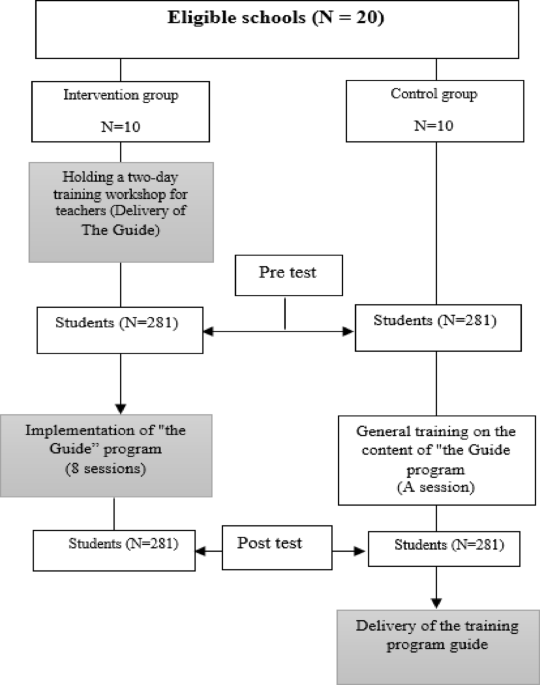
Upon receiving the code of ethics, permission, and letter of introduction from the Research Vice-Chancellor of Shahid Sadougi University of Medical Sciences, Yazd, the necessary arrangements were made with the education department of Sirjan city, and the list of first secondary schools was received. To ensure randomization, 20 schools were randomly assigned to either the intervention or control group using a random number sequence. The enrollment quota for each school is set at a minimum of 28 students. Teachers were also randomly assigned to the intervention or control groups, with 20 teachers in each group. Unwilling teachers were excluded. After describing the objectives of, they were invited to collaborate as facilitators in this study and were asked to participate in a two-day training course for the MHL program. Figure 1 shows the process of conducting the study.

A school-based mental health literacy curriculum guide, developed and tested by Kutcher et al.30 in Canada, has been translated and validated for use in Iran. This study utilized the translated version of the mental health curriculum guide. In evaluating the guide, the content validity index was measured at 0.92, and the Cronbach’s alpha coefficient was 0.82.
The teachers in the intervention group took part in a two-day training course for the school-based MHL program, consisting of six modules (1) Understanding mental health and mental illness, (2) Stigma of mental illness, (3) Information about specific mental illnesses, (4) experiences of mental illness, (5) seeking and receiving support, and (6) the importance of positive mental health.
Moreover, they were provided with the materials and contents of the Persian MHL program along with PowerPoint presentations that included the instructional material for each module (Table 1). Additionally, instructional videos, motion graphics, and key learning points from educational materials were shared through social media platforms. Upon empowering the teachers, the mental health literacy curriculum was brought into the classrooms.
Before implementing the program, the Mental Health Literacy Scale (MHLS) and the mental health knowledge assessment tool were completed by the teachers. Following the pre-test, incorrect responses were recorded. After participating in the training workshop, the teachers once again completed the pre-test questionnaires.
Written consent was acquired from parents of students under 18 years old before the start of the educational program. Each student was given an identification code by the research team, which was then completed by teachers to uphold confidentiality and anonymity. This code was employed to evaluate the students, with the assurance given to participants that their information would remain confidential.
Three questionnaires of mental health literacy scale (MHLs), mental health knowledge questionnaire (MHKQ), and attitudes to mental illness questionnaire (AMIQ) were utilized to assess the control and intervention groups, providing a thorough understanding of various facets of mental health literacy. The pre-test was administered before classroom instruction, with the post-test carried out two months following the conclusion of the sixth module.
Subsequent to the pre-test, an experienced teacher delivered the educational content of the school-based MHL program in a series of 8 sessions and was overseen by the research team with each module taught in in 60-min classes.
Out of all the modules, the third module was the most extensive and information-packed, hence needing additional teaching hours. Thus, this module was scheduled for three 50-min periods. The training incorporated interactive teaching strategies, such as group discussions, role-playing, and multimedia presentations, to enhance engagement and learning.
The trained research team, with the collaborative effort of teachers and students, introduced the main content of The Persian Guide educational program to the control group.
Following the assessment of the school-based MHL program, the Persian guide was subsequently presented to the teachers and students in the control group. The research procedure is depicted in Figure.
Questionnaires were utilized to collect data, which included the evaluation of socio-demographic characteristics, along with the “Mental Health Literacy Scale (MHLS)”, “Mental Health Knowledge Questionnaire (MHKQ)”, and “Attitudes to Mental Illness Questionnaire (AMIQ)”.
The mental health literacy scale (MHLS)
Due to the lack of appropriate instruments for measuring mental health literacy in the Iranian population, the modified version of MHLS with 29 items and six attributes can be considered a valid and reliable instrument for this purpose. The final version of the MHLS included a total of 29 items and six attributes of where to seek information (4 items), knowledge of self-treatment (2 items), ability to recognize disorders (8 items), attitudes that promote recognition or appropriate help-seeking behavior (10 items), knowledge of risk factors and causes (2 items), and knowledge of professional help available (3 items). The reliability of the tool was measured through the use of McDonald’s omega coefficient and Cronbach’s alpha coefficient, with values of 0.797 and 0.789, respectively31.
Ability to recognize disorders: This attribute consists of eight questions that were measured using a 4-point Likert scale (very unlikely, unlikely, likely, very likely). This attribute refers to “the ability to correctly identify features of a disorder, a specific disorder, or category of disorders”.
Knowledge of risk factors and causes: This attribute was measured with two questions and using a 4-point Likert scale (very unlikely, unlikely, likely, very likely). This attribute refers to “knowledge of environmental, social, familial or biological factors that increase the risk of developing a mental illness”.
Knowledge of self-treatment: was measured this attribute consists of two questions that were measured using a 4-point Likert scale (very unhelpful, unhelpful, helpful, very helpful). This attribute refers to “knowledge of typical treatments recommended by mental health professionals and activities that an individual can conduct”.
Knowledge of professional help available: This attribute was measured with three questions and using a 4-point Likert scale (very unlikely, unlikely, likely, very likely). This attribute refers to “knowledge of mental health professionals and the services they provide”.
Knowledge of where to seek information: This attribute consists of four questions that were measured using a 5–5-option Likert scale (strongly disagree, disagree, neither agree nor disagree, agree, strongly agree). This attribute refers to “knowledge of where to access information and capacity to do so”.
Attitudes that promote recognition or appropriate help-seeking behavior: This attribute consists of sixteen questions and was measured using a 5-option Likert scale [(strongly disagree, disagree, neither agree nor disagree, agree, strongly agree) or (definitely willing, probably willing, neither willing nor unwilling, probably unwilling, definitely unwilling). This attribute refers to “attitudes that impact the recognition of disorders and willingness to engage in help-seeking behavior”.
In this questionnaire, the lowest score is 35, the highest score is 160, and higher scores indicate a better MHL status. The validity and reliability of this questionnaire were evaluated in the O’Connor study. The internal consistency of this scale was measured by Cronbach’s alpha (Cronbach’s alpha = 0.90)32.
Mental health knowledge (MHKQ)
The mental health general knowledge questionnaire consists of 28 questions responded to on a 3-point scale (“True”, “False”, or “I don’t know”) based on the six modules of the guide.
The attitudes to mental illness questionnaire (AMIQ)
The Attitudes to Mental Illness Questionnaire consists of 8 questions including statements about mental disorders or people with a mental illness and asks respondents to express their level of agreement using a Likert scale (from “strongly disagree” to “strongly agree”). Mcluckie and Kutcher14 evaluated the mental health general knowledge questionnaire and attitudes to mental illness, and Cronbach’s alpha 0/71 was confirmed33.
The translation approach used in this study is based on the IQOLA standard procedure, which comprises translation phases, translation quality evaluation, reverse translation, and a comparison of the English and Persian versions by the guide’s primary developers34.
Following that, the questionnaire’s validity was examined and approved by 12 experts. The reliability was assessed by having 30 participants complete the Persian version of the questionnaire twice, with a two-week interval between each completion.
In the translation process, two questions were modified and tailored to fit Iranian culture in the translation. The average content validity index (CVI) of the items was 0.88. Cronbach’s alpha coefficient index of mental health knowledge questions and attitude to mental illness/disorders of students were obtained as 0.96 and 0.86, respectively. The Pearson correlation of the questions in the knowledge section was 0.93 and the attitude was 0.76, which are acceptable reliability coefficient.
Data analysis
To describe and analyze data, descriptive and inferential statistical methods were utilized. Qualitative variables were presented as frequency and percentage, while quantitative variables were presented as mean and standard deviation. This study assessed the normality of the data distribution by utilizing the Kolmogorov–Smirnov test. Paired t-test was used to compare the mean variables of mental health literacy and its dimensions and the knowledge and attitude of mental health in students. ANCOVA was used to compare the intervention and control groups by adjusting the effect of pre-test values. P < 0.05 was considered as a significant level. SPSS software (version 26) was used for analysis.
link
More Stories
Aaron Chan, RN Announces The QD Fund to Support Healthcare Students Advancing Mental Health and Whole-Person Care
Research on college students’ mental health education: the mediating role and the moderating effect of resource allocation
Mental Health Problems Among Medical Students | The psychological anatomy of becoming a doctor