



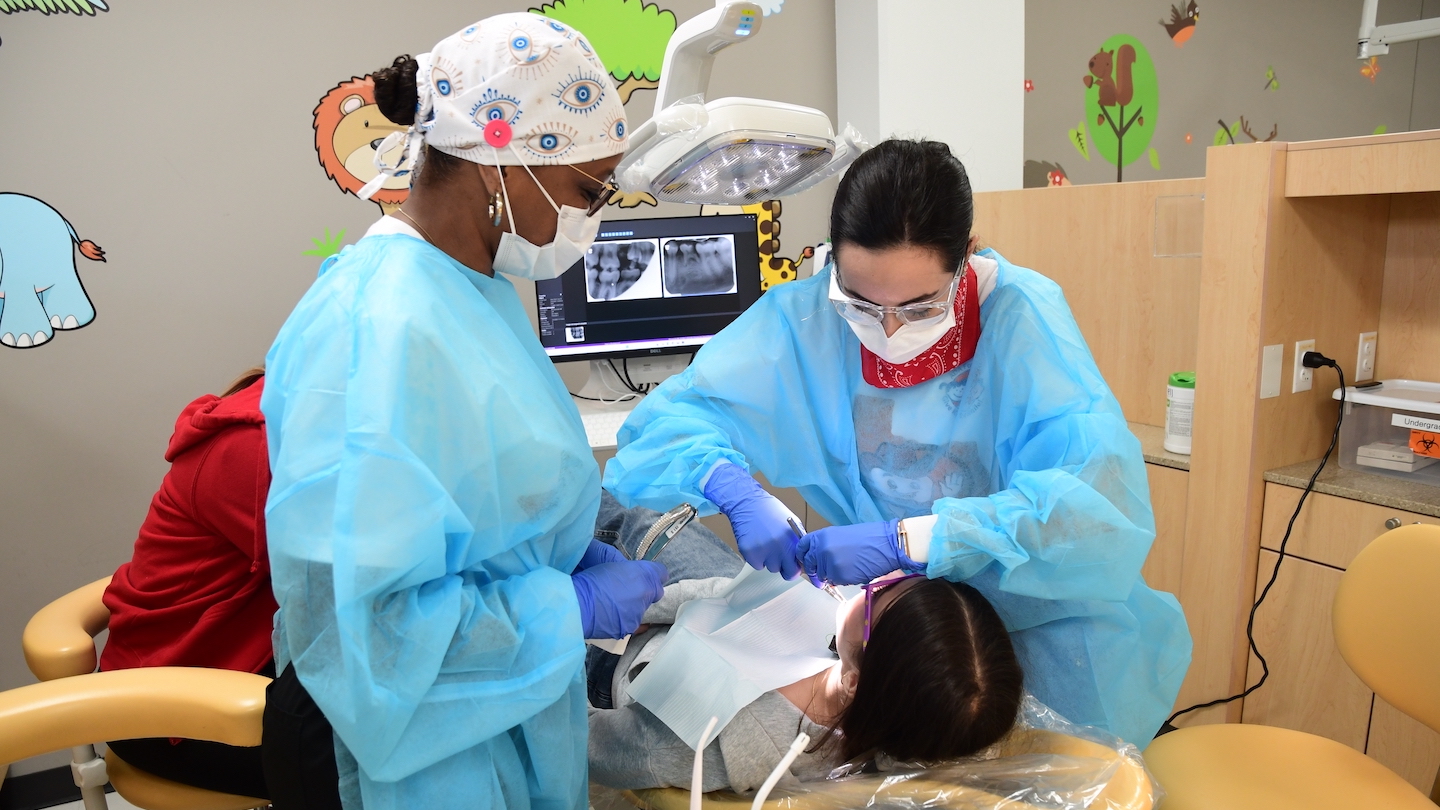
Dr. Tesha Waggoner’s pediatric dental office in southwest Portland is somewhat of a rarity in Oregon: a dentist-owned practice that accepts Medicaid for a large share of patients.
She wants to provide a “dental home” for kids regardless of income, and many of her patients are among the state’s neediest: children in foster care or with severe intellectual, developmental and physical disabilities.
“That is a patient population that I will always see in some capacity,” Waggoner said of kids with disabilities. “That’s who I believe we’re obligated to see as pediatric dentists.”
But accepting patients on the state’s Medicaid program, known as the Oregon Health Plan, can be a financial balancing act for dentists. Waggoner’s calculations were thrown off when she learned earlier this fall that a company that manages Medicaid benefits for many of her patients was cutting the payment rates she receives for providing services.
The cuts will apply to about 40% of patients at Pine Tree Pediatric Dentistry and lop off about 60% of their typical fees, she said. That’ll equal about $46,000 in the next two months, she said, forcing her to consider cutting staff hours or finding a different way to restructure her practice so that “we can continue to serve OHP patients sustainably.”
The problem is well known to the Oregon Health Authority, which last year identified the state’s low Medicaid reimbursement rates as a top reason why a majority of dentists do not accept patients covered by the Oregon Health Plan. The state pays just 28.3% of what dentists would receive from other payors, compared with 42.9% in Washington and 44.9% in California, the agency found. Dentists also told Oregon researchers that Medicaid carried a higher paperwork burden than some other insurances.
That’s resulted in a broad lack of access to oral health care for children and adults on the Oregon Health Plan: 32 of the state’s 36 counties have too few dental care providers who accept the public insurance to adequately serve everyone who is enrolled, researchers for the state and Oregon Health & Science University found in their report. The latest data from the American Dental Association showed that as of 2019, 58.8% of dentists in the state were not enrolled to accept Medicaid.
It’s a problem that spans Oregon’s most populous metro areas and rural counties.
Oregon Health Authority leaders and experts declined an interview request from The Oregonian/OregonLive to discuss how the agency is addressing the lack of oral health care providers for people on Medicaid. In an emailed statement, a spokesperson for the agency noted that states are only mandated to provide Medicaid dental coverage to children and young adults through age 20. States can choose to skip coverage for adults, but Oregon provides coverage.
“Oregon has strived to expand access to oral health care for OHP members over the years,” spokesperson Kristen Lambert wrote in an email. She pointed out that Oregon leaders used the Medicaid expansion under the Affordable Care Act to expand adult dental coverage in 2014 “from offering only emergency services to a more comprehensive preventative and routine dental care program.”

“We’re extremely lucky to have good insurance,” Kimberly Markel said. “And we have a good dentist, too.” Pham said he sees a mix of patients covered by commercial insurance, like Makelina, and children on the Oregon Health Plan.Beth Nakamura
One patient population for whom Oregon expanded increased payment rates in recent years was children and young adults with special health care needs, raising the fee schedule by an average of nearly 50%, Lambert said.
For Hayley Palmer of Tualatin, however, it remains challenging to schedule dental care for her daughter, Mila. The 9-year-old has severe cerebral palsy and has been on the Oregon Health Plan her entire life. “We’ve always had to rely on who we can go to with that,” Palmer said.
Mila uses a feeding tube and has some specific challenges to receiving dental care, including her risk of aspiration and aversion to having instruments such as toothbrushes in her mouth, Palmer said. She goes to Doernbecher Children’s Hospital in Portland, where she recently had several procedures completed while she was sedated: x-rays, a teeth cleaning and the removal of eight baby teeth to allow her adult teeth to come in.
Palmer said teeth cleanings are important because bacteria from the mouth can cause pneumonia, “which can be deadly for a child like mine.” Cleanings also help Mila to look her best. “When you have a child who is really, really different outwardly looking, having something as simple as clean teeth makes a big difference,” Palmer said.
Finding dentists who accept children with special health care needs and take Medicaid can be especially challenging. One day when Palmer was at Portland Shriners Hospital for Children, she happened upon a list of dentists who supposedly accepted both. “I called every one of them on the list and half of them said they don’t take OHP or kids with specialized needs,” Palmer said.
Dr. Hai Pham, a pediatric dentist who practices in Portland-area hospitals and has clinics in Washington County, said the state’s low Medicaid rates force dentists to limit the number of Oregon Health Plan patients they accept.
“The only way some practices do it, like mine, is we see a fair number but we have to balance it with private insurance, private pay” patients, Pham said. “If everything I did was Medicaid, I’d be in the red. I couldn’t pay my staff.”
Pham, a Democratic state representative, estimated that children on the Oregon Health Plan account for approximately 10% of the patients at his practices. He said the additional administrative work required for Medicaid, including different reporting requirements for various Medicaid benefits managers in Oregon, also deters dentists from accepting patients. “A lot of my colleagues would rather do it for free than take Medicaid,” he said.

On top of that, Pham said dentists face financial jeopardy if too many patients fail to show up for appointments. Life challenges associated with poverty, such as a lack of reliable transportation, can increase the odds of someone on the Oregon Health Plan not showing up for an appointment, Pham said. “All those things accumulate so providers are like, ‘I just can’t do it.’”
Still, Pham said he always felt it was important to “pay it forward” in recognition of the dentists who helped his family after they arrived as refugees from Vietnam. His experience struggling to pay for his own leukemia treatment in 2007 also brought home that “it’s not these kids’ fault, or adults’ fault, they can’t afford care.”
Pham and Rep. Cyrus Javadi, a Democratic state representative who owns a dental practice in Tillamook, co-sponsored a proposal during the legislative session earlier this year that would have required the state’s Medicaid program and benefits managers to pay nearly 60% of the average rate paid by other insurers for dental care. The bill died in committee without ever receiving a cost estimate. Raising rates would likely require the state to trim spending in other areas.
“At the end of the day, it’s 100% about reimbursement,” Javadi said of Oregon’s shortage of dentists who accept Oregon Health Plan members. “They’re not even covering … what it costs to provide the treatment.”
Javadi said in his experience, Medicaid does not pose too high of an administrative burden. His practice typically sees 30% to 40% Medicaid patients, which they balance financially with patients who pay cash or are covered by commercial insurance.
Javadi said dentists in rural areas face particular challenges attracting enough providers to serve patients on the Oregon Health Plan. There are fewer amenities to attract people and often fewer continuing training opportunities. “It becomes more expensive to bring people out to the coast.”
For now, Javadi sees little indication that state leaders are looking to improve dental access. “That doesn’t seem to be a priority for the state at this point,” he said.
If you purchase a product or register for an account through a link on our site, we may receive compensation. By using this site, you consent to our User Agreement and agree that your clicks, interactions, and personal information may be collected, recorded, and/or stored by us and social media and other third-party partners in accordance with our Privacy Policy.
link
More Stories
Give Kids A Smile 2026 kicks off in Houston
Free Dental Program Targets Early Prevention for Kern County Children
Give Kids Smile Day Promotes Lifelong Dental Health