



To begin, let’s discuss the alignment between Olympus’s mission and vision. Olympus has long positioned itself as a global leader in endoscopic care. Now, as healthcare rapidly evolves into a new digital era, aligning the corporate mission with technology strategy becomes ever more crucial. My first question for you, Mr. Kierner, is: How does Olympus’s digital strategy support its mission to serve the entire gastrointestinal (GI) patient journey—from diagnosis to treatment and beyond?
Thank you for that question. I’d like to start by reaffirming Olympus’s enduring vision, which is to make people’s lives healthier, safer, and more fulfilling. There is a clear and essential connection between this vision and what we can achieve through our digital strategy. Fundamentally, digital technology empowers us to improve clinical workflows and, most importantly, save lives.
Take colorectal cancer as an example. It is a leading cause of cancer mortality worldwide, yet it remains one of the most preventable forms of cancer. Unfortunately, over 5,000 new cases are diagnosed each day globally, and more than 2,500 lives are lost daily to this disease. Our digital solutions aim to enhance detection rates dramatically. Early detection is paramount—the earlier colorectal cancer is identified, the better the treatment options and patient outcomes. By increasing detection accuracy and speed, we improve the entire care pathway, ultimately saving more lives.
Moreover, our solutions address hospital operational challenges by alleviating some of the procedural burdens that can limit patient access to vital screenings and treatments. In this way, our digital strategy not only supports clinical excellence but also fosters broader healthcare accessibility.
Building on that, I recall speaking last year with Olympus experts about the importance of continuous, data-driven impact across patient care—a vision that is ambitious and increasingly dependent on emerging technologies like AI and cloud connectivity. Could you elaborate on the role that artificial intelligence and connected care play in realizing Olympus’s vision of continuous impact throughout the patient care pathway?
Absolutely. When we discuss AI, it’s important to consider two complementary dimensions.
First, AI enhances traditional clinical workflows by augmenting physicians’ capabilities. For example, during endoscopic procedures, AI can assist in detecting adenomas—precancerous polyps in the colon—with greater accuracy and consistency than human observation alone. Our approach integrates AI with Olympus’s legacy of world-class optical and digital imaging technology. By feeding high-quality endoscopic video data into advanced AI models, we create tools that significantly improve polyp detection and diagnostic precision.
Second, AI has a vital role in alleviating systemic pressures on healthcare institutions. Hospitals today face escalating procedural volumes, workforce shortages, and growing demands to improve patient outcomes—all while managing constrained budgets. AI offers a means to reduce operational burdens, streamline workflows, and enable care teams to do more with less.
This is not about amplifying existing constraints but innovating to overcome them. By embedding AI into a connected, cloud-based patient care ecosystem, we support a continuous and integrated care pathway that benefits both clinicians and patients alike.
Turning to end-to-end gastrointestinal workflow integration, Olympus operates across the entire GI spectrum—from early screening devices to therapeutic instruments. This ability to integrate digital tools at every stage could be a key differentiator. How is Olympus uniquely positioned to connect digital solutions across the full GI continuum—from early detection through to post-treatment monitoring?
Olympus has a deep-rooted history and extensive distribution network for our endoscopic devices, which enjoy tremendous trust and widespread adoption among physicians worldwide. This gives us both a unique opportunity and a responsibility to integrate our AI and digital tools seamlessly with our endoscopes, enabling superior data capture and signal processing.
But the GI patient journey is far more complex than just the procedure itself. It encompasses patient intake, the procedure, post-procedure scope processing, maintenance, and servicing. By integrating data from all these phases, we can significantly simplify hospital workflows, reduce operational burdens, and cut costs. The cloud-connected ecosystem we provide acts as a platform that orchestrates this full workflow efficiently, enabling hospitals to operate their GI departments more effectively.
Looking at the broader digital transformation in gastrointestinal care, new technologies are unlocking possibilities—from enhanced diagnostics to streamlined clinical workflows. As a leader in this field, Olympus is helping shape where the most substantial gains can be made. Could you discuss the biggest opportunities for digital transformation in GI care that Olympus is addressing today?
Certainly. As someone deeply immersed in digital innovation and AI, I firmly believe that digital transformation represents one of the greatest opportunities to support hospitals facing mounting pressures—rising costs, increasing patient volumes, and an aging population driving greater prevalence of GI diseases.
Digital technologies enable us to optimize workflows, improve efficiency, and enhance care quality. While many smart startups are innovating in niche areas, hospitals need partners who can deliver comprehensive, scalable solutions that integrate seamlessly across the full care pathway.
It’s relatively straightforward nowadays to develop an AI tool for a specific task, but the challenge lies in integrating multiple tools without overwhelming hospital IT departments. That’s where Olympus’s holistic approach comes in: we manage the entire GI workflow—from patient intake to scope reprocessing—providing an integrated platform that elevates care quality and operational efficiency far beyond what fragmented innovations can achieve.
Moving to cloud and connected infrastructure, with healthcare shifting toward cloud-first ecosystems, the ability to remotely manage devices, data, and diagnostics is becoming a strategic advantage. How can hospitals leverage Olympus’s cloud-based platforms to optimize device updates, data sharing, and clinical workflows?
Your question captures the essence of the future of healthcare technology. Today, hospitals don’t just purchase a device as a static product; they invest in a connected system that can continuously evolve.
Olympus’s cloud-based platforms enable remote device updates, meaning that clinical tools like our AI-assisted polyp detection system can improve over time without requiring new hardware. Since the processing occurs in the cloud, we can regularly update algorithms and incorporate new data from the latest devices, ensuring that hospitals benefit from ongoing innovation.
Beyond diagnostic tools, our cloud ecosystem connects to scope processing machines and vision controllers, allowing us to monitor performance, schedule maintenance proactively, and optimize equipment uptime. This reduces unnecessary service visits and minimizes procedural interruptions, thereby improving patient access and operational efficiency daily.
Endoscopy suites are evolving into intelligent, connected environments. This transformation offers more than convenience; it holds the potential for meaningful operational and clinical improvements across entire health systems. Could you discuss the benefits of such a connected ecosystem for hospitals, especially regarding operational efficiency and patient outcomes?
Let’s begin with patient outcomes, which remain our highest priority.
Our clinical studies demonstrate that integrating AI technology into endoscopic procedures leads to more than a seven percent absolute increase in adenoma detection rates—a significant improvement considering the high stakes involved. Particularly for challenging-to-detect lesions, such as sessile serrated polyps (SSLs), AI assistance more than doubles detection effectiveness compared to human observation alone.
However, the benefits extend well beyond detection. Our connected platform is designed to streamline the entire clinical workflow—from automating report generation to reducing the cognitive load on clinicians who otherwise must document procedures manually. By easing these burdens, clinicians can focus more on patient care.
On the operational side, endoscope reprocessing and maintenance are complex tasks that directly impact procedure availability and patient safety. By integrating data from processing machines, scopes, and vision systems into a unified ecosystem, we enable more predictable, efficient operations with fewer interruptions—ultimately expanding patient access to critical GI procedures.
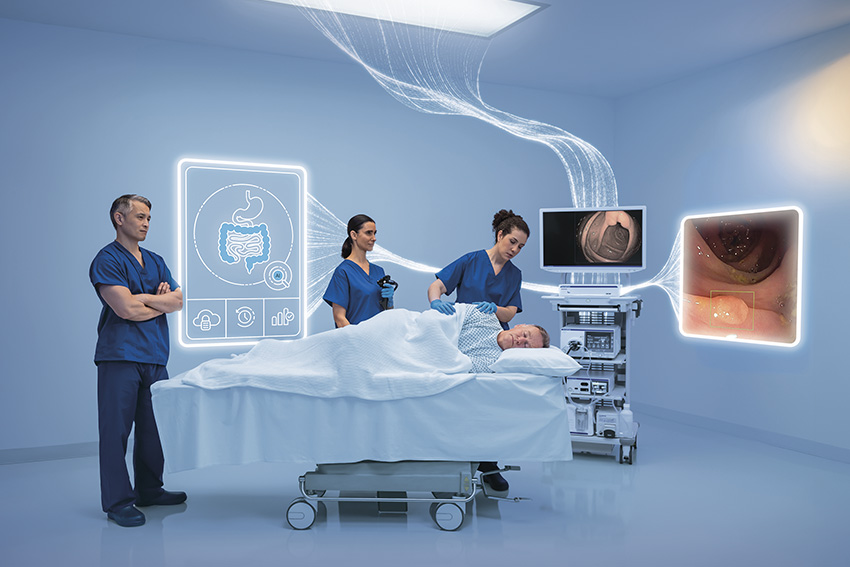
The CADDIE™ computer-aided detection software, one of the CAD/AI apps on the cloud-based, AI-powered OLYSENSE™ platform, aids in the detection of high-risk and hard-to-detect colorectal lesions during colonoscopies.
Turning to value creation—a critical concern given the global pressures on health systems to do more with less, including challenges like the nursing shortage. Investments in digital platforms must now demonstrate tangible returns, not only clinically but across the entire care value chain. Could you elaborate on why Olympus—and you personally—believe it is essential for healthcare systems to invest in digital platforms spanning the full care pathway? Can you quantify this value?
Certainly. Our close collaboration with hospital partners has given us deep insights into operational constraints—nursing shortages being a key example. Some projections estimate a global nursing shortage of up to six million by 2040, which will only intensify the pressures on healthcare systems.
Our innovation centers on alleviating such constraints. For instance, our intelligent platforms can capture clinical notes automatically, reducing or eliminating the need for nurses to spend time on documentation after procedures. We also provide real-time visibility into scope readiness and processing status, minimizing unnecessary trips and ensuring that equipment is available when needed.
Furthermore, we address patient-related workflow inefficiencies, such as appointment no-shows, through digital tools that improve scheduling and resource utilization. All these elements contribute to smoother, more efficient GI departments capable of handling increased patient volumes without proportional increases in staff or costs.
There is often tension between clinicians who seek tools that enhance care and administrators who focus on operational efficiency. Demonstrating value to both groups is crucial for adoption in today’s outcomes-driven healthcare environment. How does Olympus showcase the value of its digital innovations to both clinicians and hospital administrators?
We are fortunate to be able to demonstrate clear, quantifiable value to both groups.
Clinically, we conduct rigorous studies—such as those on our KAI (Kudo AI) polyp detection system—that prove improved patient outcomes, which naturally excite and engage physicians eager to adopt innovations that enhance care. Our tools are designed to assist rather than overwhelm clinicians, providing timely, actionable insights during procedures without unnecessary alerts.
From an administrative perspective, our solutions help hospitals increase revenue by enabling the detection and removal of more polyps, which directly translates to more reimbursable pathology tests. Additionally, by streamlining workflows, reducing clinician burden, and minimizing unplanned interruptions, hospitals can perform more procedures efficiently.
This dual focus ensures that our digital innovations deliver better care, higher clinician satisfaction, and improved operational and financial performance—a compelling value proposition for the entire healthcare ecosystem.
I want to shift the focus now to continuous impact—from diagnosis to treatment. Digital tools are no longer confined to single procedures; they increasingly support patients throughout multiple stages of care. Olympus’s digital ecosystem appears designed with this continuity in mind. Could you share an example of how your digital tools have improved outcomes across multiple stages of care?
Certainly. The study I mentioned earlier illustrates this well. Beyond a 7.3 percent increase in overall adenoma detection rates, we observed a more than 100 percent increase in detection of larger polyps and sessile serrated lesions (SSLs)—lesions that are particularly important yet challenging to identify.
This enhanced detection capacity directly improves diagnostic accuracy and patient outcomes. Importantly, our collaboration with key opinion leaders (KOLs) and physicians extends into treatment innovations as well, ensuring that our digital tools support not only diagnosis but also therapeutic interventions and follow-up care.
The true value of digital health lies in what happens after the procedure—how care continues, evolves, and improves over time. This ongoing impact requires continuous measurement. How does Olympus assess the lasting impact of its digital solutions beyond the initial diagnosis or procedure?
From the outset, our technologies empower hospital partners to collect significantly more comprehensive data about each procedure and the overall operation of their GI departments. Our analytics and insights platforms provide actionable information on operational efficiency and patient outcomes, helping hospitals continuously refine their processes.
We also actively support hospitals in implementing these insights through service arrangements and ongoing tool enhancements.
Looking forward, there is tremendous potential to leverage additional data signals extracted from endoscopic videos and other clinical inputs. Collaborating with physicians and medical societies worldwide, we are developing ways to harness this data—augmented by AI—to drive the future evolution of GI care, particularly in cancer prevention, which remains a noble and critical mission.
Finally, innovation inevitably brings complexity. Olympus is at the forefront of the digital frontier, navigating challenges such as regulatory requirements, interoperability, clinician trust, and return on investment. As the saying goes, “Rome wasn’t built in a day.” What do you see as the biggest challenges Olympus faces, and how do you believe the company will overcome them?
You’ve touched on some of the most complex and shared challenges across our entire healthcare ecosystem. I remain optimistic because many emerging technologies, particularly in AI, hold the potential to help us address these challenges effectively.
At Olympus, we adopt a rigorous, risk-based approach. We have a long-standing reputation as a high-quality provider of endoscopy solutions and a trusted partner to physicians. Maintaining this legacy is paramount. Therefore, we prioritize quality and future-proofing in our product development, which sometimes means taking additional time to meet stringent regulatory standards before market launch.
Though this cautious approach can slow speed to market, it ensures that when our solutions are released, they are reliable, effective, and durable—a differentiator that customers expect from a company of our stature.
Interoperability is another critical area. Olympus brings extensive experience integrating our solutions with diverse electronic medical records (EMRs) across multiple regions—including Europe, the United States, and Japan. Our products are designed to operate cohesively within hospital IT infrastructures, orchestrating GI workflows seamlessly.
With the transition to cloud-based technologies, we are innovating further to enhance connectivity and user experience, drawing inspiration from consumer apps that many of us use daily. We believe that healthcare will increasingly benefit from these more intuitive, efficient, and integrated digital experiences.
In summary, by combining steadfast quality standards, deep integration expertise, and cutting-edge cloud innovation, Olympus is well-positioned to overcome the complexities of digital transformation in healthcare.
Dr. Kierner, thank you very much for sharing your insights today. It has been a genuine pleasure speaking with you.
Thank you very much. It’s been a pleasure to engage in this thoughtful conversation
link
More Stories
Pediatric Gastroenterology – MU Health Care
Leading Gastroenterology Hospitals Advancing Digestive Care in India
Mobile ‘Endoscopy on Wheels’ Delivers Lifesaving Gastrointestinal Care