




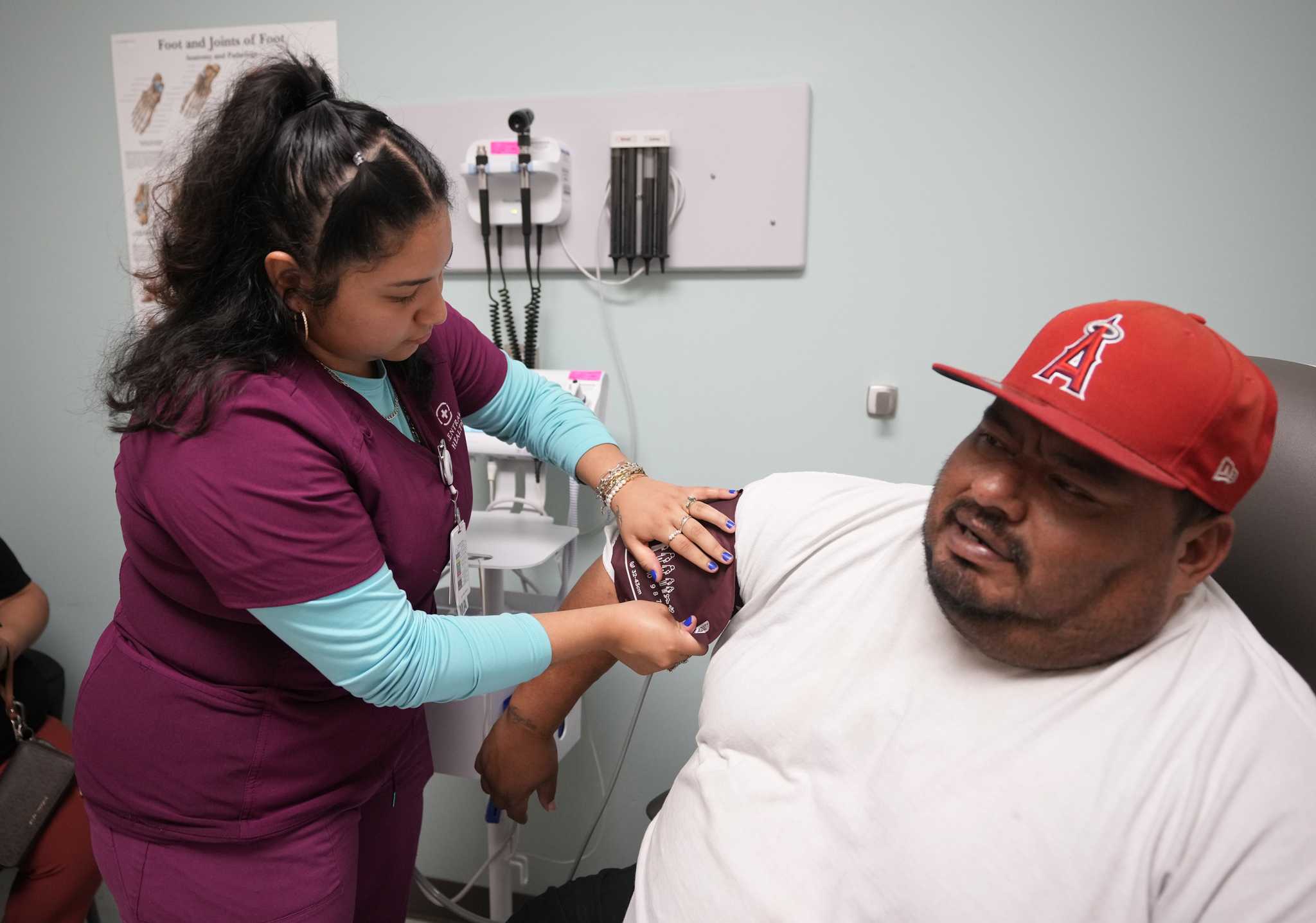

Medical assistant Sarai Vences takes the blood pressure of patient Eloy Herrera at the Central Health East Austin Specialty Clinic in Austin.
Do you understand your blood pressure numbers?

The American Heart Association and the American College of Cardiology came up with new recommendations that encourage doctors and patients to be more proactive to try to get those numbers into a healthy range. Now doctors should be using a cardiac disease risk calculator that considers other diseases, kidney function, weight and other factors, in addition to the blood pressure reading.
Article continues below this ad
What are normal and abnormal blood pressure numbers?
- Normal blood pressure is less than 120/80 mm Hg (which stands for millimeters of mercury)
- Elevated blood pressure is 120-129 mm Hg and less than 80 mm Hg
- Stage 1 hypertension is 130-139 mm Hg or 80-89 mm Hg
- Stage 2 hypertension is more than 140 mm Hg or more than 90 mm Hg
Systolic is the top number in a blood pressure reading and refers to the amount of pressure in the arteries while the heart is beating. Diastolic is the bottom number and refers to the amount of pressure in the arteries while the heart is resting between heartbeats. Younger people tend to have more problems with the bottom number.
“Just 10 mm HG above either one of these numbers increases the risk of stroke by twice,” said Dr. Sameer Waheed, an interventional cardiologist with Heart Hospital of Austin and Austin Heart.
Article continues below this ad

Sameer Waheed is an interventional cardiologist with Heart Hospital of Austin and Austin Heart.
What should you do if your blood pressure isn’t in range?
First, one abnormal reading does not mean you have high blood pressure. You should take it again after resting.
Article continues below this ad
Instead of putting someone on medications right away, the American Heart Association recommends giving people three to six months to make lifestyle changes including a healthful diet, increasing exercise and losing weight to lower those numbers. If the numbers still don’t go down or if a person is unwilling to make changes, then medication is advised.
However, the guidelines now include the PREVENT calculator for cardiovascular disease to predict what the risk could be in the next 10 to 30 years for people ages 30 to 79. PREVENT stands for Predicting Risk of cardiovascular disease EVENT.
Here’s what PREVENT looks at:
Article continues below this ad
- Age
- Gender at birth
- Blood pressure
- Total Cholesterol
- HDL Cholesterol
- Body Mass Index
- Sistolic blood pressure
- Estimated glomerular filtration rate (how well your kidneys are filtering)
- Diabetes
- Smoking
- Taking blood pressure medicine
- Taking cholesterol medicine
- And then optionally urine albumin-creatinine ratio (the overall health of your kidneys)
- A1C (the three-month calculation of blood sugars for diabetes)
- ZIP code (for social determinates of health risk factors)
In addition to all of this information in the PREVENT calculator, the new guidelines also recommend getting the urine albumin-creatinine ratio test for everyone who has high blood pressure as well as doing a plasma aldosterone-to-renin ratio test for anyone with sleep apnea, which can indicate a condition that causes elevated blood pressures but low potassium levels; and screening for primary aldosteronism (the condition above) for anyone in stage 2 hypertension.
What else is in the new guidelines?
More attention is paid to high blood pressure and dementia and cognitive decline. High blood pressure can damage the small vessels in the brain, which then leads to memory problems.
Article continues below this ad
Because of this, people who have a systolic number above 130 mm HG should be given treatment earlier to prevent cognitive damage.
The guidelines also acknowledge that often — especially in people who have diabetes, obesity or kidney disease — more than one medication to lower blood pressure might be needed and more than one type of medication. People who have blood pressures above 140/90 mm HG can start with more than one medication or a combination pill.
The guidelines allow for some people who have high blood pressure and are also diabetic or obese to start GLP-1 medications, which have brand names like Ozempic or Wegovy. And the guidelines remind that blood pressure problems in pregnant women can create serious problems during the pregnancy, immediately after and years later.

Medical assistant Jalen Reasonover of the Central Health Mobile Bridge Clinic checks the blood pressure of Aldophine Mukendi.
What about low blood pressure?
Well, that isn’t good either. Anything below 110 as the top number is of worry, especially in older people because of the risk of falls and organ damage.
Article continues below this ad
When and how should you take your blood pressure?
Waheed recommends using a blood pressure cuff rather than a wrist monitor, and coming into the doctor’s office to see if it is calibrated to the readings in the clinic. You also can look up which blood pressure monitors are validated on the website validatebp.org.
The American Heart Association recommends these actions:
Article continues below this ad
- Don’t take blood pressure 30 minutes after smoking, drinking caffeine or exercising.
- Remove clothing on the arm you will use.
- Rest five minutes before taking measurements
- Do not talk or talk on the phone while taking your blood pressure
- Sit with your arm on a flat surface at heart level
- The middle of the cuff should be on the upper arm at heart level and the bottom should be above the bend in the elbow
- Measure your blood pressure at the same time every day and take two readings one minute apart.
link
More Stories
Do No Harm: Rethinking Diabetes, Hypertension in Frail Older Adults
JSH2025 guidelines for hypertension management in older adults: international comparison
Women with pre-pregnancy high blood pressure face breastfeeding challenges, Ohio University study suggests