




See the full list of this year’s Top Dentists
Beginning with the End in Mind
A daughter of immigrant parents, Dr. Suzan Ekim grew up in a low-income neighborhood in Toronto with an older sister and a single mother who took the bus to work. Because her family didn’t have a car, 12-year-old Ekim walked to her monthly orthodontist appointments over the course of a year and a half. When she was done with her braces and headgear, her teeth were aligned, as were her future aspirations. “I watched all of this, saw how it was working, and just thought, ‘This is something I would like to do.’”
Thanks to supportive mentors and a good dose of determination, Ekim became an orthodontist at age 26, a few years earlier than many of her peers. She couldn’t be happier with her career choice, and now, she’s had her own practice, Ekim Orthodontics, in Prior Lake and Burnsville, for 18 years. Ekim loves blending together science and art and compares orthodontics to putting together a puzzle, whether it’s 500 or 5,000 pieces. “I kind of see that picture at the end—before it’s made,” Ekim says. “Someone walks in with all the pieces all over the place in different spots depending on the complexity of this puzzle, and I visualize the end—how I’m going to get there.”
Ekim enjoys working with her patients, helping them see their own potential and strength. Some are nervous, especially tweens and teenagers who imagine the road ahead and might feel it’s “a lot bigger than it really is,” she says. Ekim makes sure to boost their confidence. “I tell them I have done this thousands of times, so I’m not nervous,” she says.
With pressure from society and social media to look their best, Ekim’s young patients are interested mostly in the aesthetics of a good-looking smile. Ekim is thrilled to help them achieve these goals. However, she realizes a healthy smile—one that looks good and functions well—will serve her patients of all ages well into the future. “You want to keep your teeth for a very long time,” Ekim says. “Aligned teeth and leveled bites are going to last longer and have less issues as you get older.”
That’s because it’s easier to brush and floss straight teeth than it is to care for overlapping and crowded teeth, which can lead to bone loss and gum disease. A bonus down the road can also be better cardiovascular health, hygiene, and breathing. “I’d like dental issues to be low on the list of problems when you get to those aging areas,” she says.
While Ekim can see how building—and maintaining—a structurally healthy smile will benefit her patients long into the future, she’s still unsure what exact role predictive AI will have in the field of orthodontics. AI’s goal is to improve accuracy, diagnostics, and outcomes. And while it’s easy to manipulate teeth virtually and theoretically, Ekim notes, “real people are made out of bone and blood and muscles, and they’re growing and changing.”
AI can’t rely on or assume a set pattern for development for each patient or foresee the unique changes and potential outcomes for individual patients. For example, 12-year molars generally erupt between ages 10 to 14, but some can emerge from ages 8 to 21. “The variation of understanding how teeth move through bone, the biomechanics, the velocity of the movement, what’s healthy for this patient, and the goals of this patient—that’s all missing from just an AI-generated plan,” she says. “It could get you closer…or started, at least. But it needs to be customized by an orthodontist.”
Ekim is thankful and inspired to be in a position to do just that.
See the Top Dentist Hall of Fame
Building Trust with Younger Patients
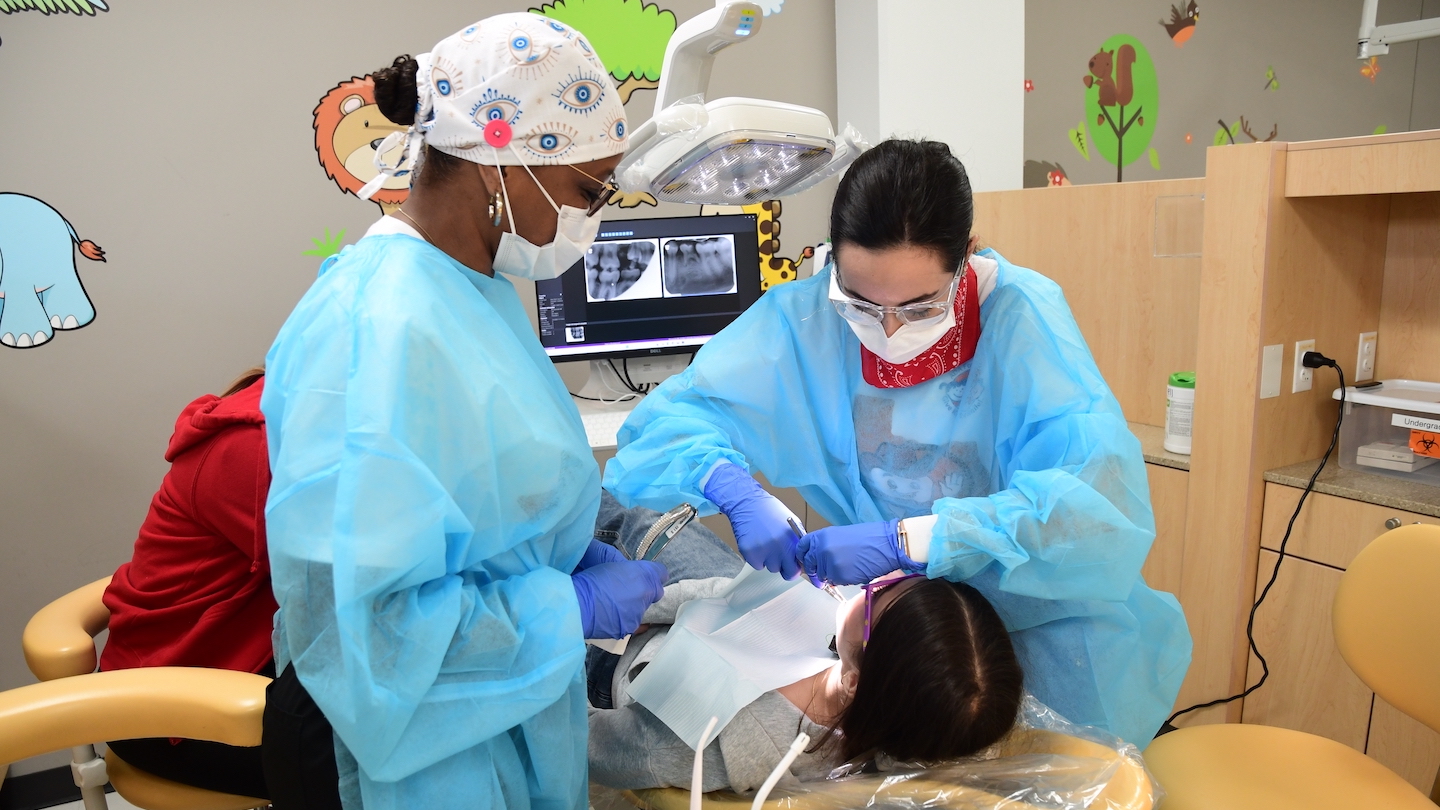
Dr. Michele Olson is passionate about caring for the dental needs of underserved patients with disabilities. This focus emerged soon after she received her DDS from the University of Minnesota and began working at a community clinic serving a patient population that required extra care.
Not long after she started practicing at that clinic, her daughter was born with Down syndrome. Two years later, her son was born. In the midst of this, a spark inside her ignited, one she’d already been fostering, to work in pediatric dentistry and help kids, especially those with unique challenges and needs.
Today she is a dentist at MapleTree Pediatric Dentistry, with locations in Maplewood and Forest Lake. Olson estimates that 20 to 30 percent of the clinic’s young patient population has special health care needs.
Introducing a child to dental care can be stressful enough, and for parents who have children with special needs, the process can be overwhelming. Some might feel lost in trying to find the right dentist to care for their child. “We’ve had parents break down and cry,” Olson says. “They’re like, ‘Thank you for being here.’”
That’s because a visit to the dentist can feel intimidating to any child—especially to one who has a medical complexity. Olson makes sure her young patients feel safe and comfortable. “I’ll go out into the waiting room or even the car to do their exams because they just can’t handle different environments,” Olson says. “So, we try and meet the child and provide them with the type of environment that they thrive best in.”
Olson and her colleagues want each child to have a positive experience. “We do a lot in our clinic to try and help the child overcome fears and sensitivities,” Olson says. That might be in the form of happy visits, where a child comes in every three to four months without getting any dental work done. They might sit in the chair, check out the dental equipment, and take home a toy. Those who are willing to undergo a dental checkup have the option to check off various dental to-dos from a checklist—and can do so in one visit or multiple visits. Fidget toys, dimmed lights, headphones, and weighted aprons are other things that can help make it a comfortable visit. “We try to build a rapport with the child instead of just getting it done,” she says.
Some patients have more complex needs due to feeding tubes, oral aversions, or sensitivities to different textures and tastes. Olson customizes the care plans to address the needs of these young ones and also teaches their parents the best way to care for their children’s oral health at home.
Olson, who also volunteers as chair of the Down Syndrome Association of Minnesota, serves as a faculty advisor for American Academy of Developmental Medicine and Dentistry at the U of M, acts as a clinical advisor for Special Smiles for Special Olympics, and teaches part time in the pediatric department and the Special Healthcare Needs Clinic at the U of M, can see her hard work is paying off. “I love seeing the growth and the change in these kids—watching them go from potentially really scared and doubtful to just thriving,” she says. “And to be able to be a light and to be able to support them and be there for them, it just means everything. I love going to work. I love what I do.”
Olson’s children, 15-year-old Evelyn and 13-year-old Henry, who inspired her all those years ago, are also thriving today. Currently, as part of MyTeam Triumph, which allows runners to push individuals in running strollers, Olson is training for a marathon in which she and her daughter will cross the finish line together.
The 2026 Top Dentists List: The Process
See the full list of this year’s Top Dentists
Oral health can affect not only how we feel and function on the inside but also how confidently we face the world outside. No wonder we attach such importance to choosing the right professional for everything from routine checkups to specialized care and services. The following list contains approximately 10 percent of active dentists in the 10-county metro area. Dentists pass through a multistep process before their names appear here.
As you can imagine, research is essential. We started by asking Twin Cities dentists to nominate other dentists they consider to be exceptional in the field—peers they would consult if they were seeking care. From there, we grouped candidates into specialties and evaluated myriad factors, including (but not limited to) peer recognition, professional achievement, and disciplinary history. Dentists who amassed the highest scores from each grouping were invited to serve on a blue-ribbon panel to evaluate the other candidates. At the end of this process, we selected Mpls.St.Paul Magazine’s 2026 Top Dentists, picking only dentists who had acquired the highest point totals from the surveys, research, and blue-ribbon panel review.
Of course, no list is perfect. Many local dentists who provide excellent care may have missed this year’s list. We also cannot guarantee that all dentists listed here are available for new patient visits. However, if you’re looking for exceptional dentists who have earned the confidence and high regard of their peers, you can start your search here.
In addition to our local list, this year’s class of Mpls.St.Paul Magazine Top Dentists will join a prestigious group of colleagues, Super Dentists®, from areas around the country. That full list appears at superdentists.com.
Finally, it’s important to note that there is a strict separation between our list and the advertising that appears in this publication. Advertising has no bearing on the names found here. For more information on research and methodology, please go to superdentists.com.
© MSP Communications 2026. Super Dentists® is a registered trademark of MSP Communications. All rights reserved. Disclaimer: The information presented is not medical advice, nor is Super Dentists a dental care referral service. We strive to maintain a high degree of accuracy in the information provided. We make no claim, promise, or guarantee about the accuracy, completeness, or adequacy of the information contained in the directory. Selecting a dental care provider is an important decision that should not be based solely on advertising. Super Dentists is the name of a publication, not a title or moniker conferred upon individual dentists. No representation is made that the quality of services provided by the dentists listed will be greater than that of other licensed dentists, and past results do not guarantee future success. Super Dentists is an independent publisher that has developed its own selection methodology; it is not affiliated with any federal, state, or regulatory body. Self-designated practice specialties listed in Super Dentists do not imply “recognition” or “endorsement” of any dental specialty certification board, or that the dentist has been trained or has special competence to practice in that area. List research concluded November 3, 2025.
link
More Stories
Give Kids A Smile 2026 kicks off in Houston
Free Dental Program Targets Early Prevention for Kern County Children
Give Kids Smile Day Promotes Lifelong Dental Health